
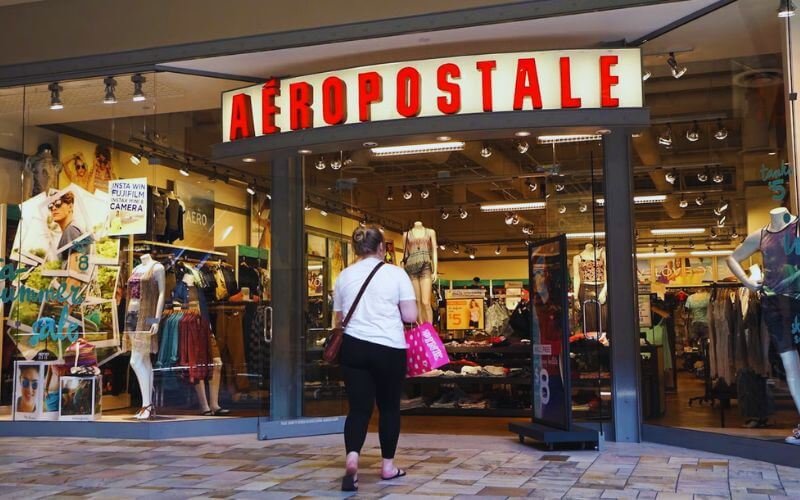


If you walked through a mall around 2016 and saw an Aeropostale store covered in “Going Out of Business” signs, you probably assumed the brand was finished. A lot of people did. But that assumption wasn’t entirely accurate — and the real story is worth understanding, especially if you follow retail or run a business yourself.
This article explains what actually happened: the 2016 bankruptcy, what caused it, how the brand was rescued, who owns it now, and where it stands today.
Aeropostale Filed for Bankruptcy in 2016 — But Did Not Shut Down
Here’s the short answer: Aeropostale did not go out of business. It filed for Chapter 11 bankruptcy protection in May 2016, which is a reorganization process — not a liquidation. The company kept operating while it restructured.
During the process, 113 U.S. stores and all 41 Canadian locations were closed. That’s roughly 154 stores out of a total base of around 739 to 800 locations at the time. The closing stores ran going-out-of-business sales, which is where most of the public confusion started. People saw those sales and assumed the whole chain was done.
It wasn’t. The brand survived, was acquired by new owners, and continues to operate today. As one Reddit user put it plainly: “They went bankrupt in 2016… They are still there. They just contracted heavily.”
That’s about as accurate a summary as you’ll find.
What Pushed Aeropostale to the Edge
The bankruptcy didn’t come out of nowhere. Aeropostale reported 13 consecutive quarters of losses before the May 2016 filing. That’s more than three years of sustained financial decline.
The core problem was a mismatch between what the brand sold and what its customers wanted. Aeropostale built its identity around logo-heavy basics — graphic tees, hoodies, simple denim. That formula worked well in the mid-2000s. By the mid-2010s, teen fashion had moved on.
Competitors like H&M and Forever 21 were offering more trend-driven styles at similar or lower prices. Online retailers were pulling shoppers away from malls entirely. Aeropostale’s product lineup looked dated, and its store model depended on foot traffic that was steadily disappearing.
There was also a serious financial dispute with Sycamore Partners, which had served as both a supplier and financing partner. When that relationship broke down, a bankruptcy judge allowed Sycamore to credit-bid $150 million it was owed — a move that pushed Aeropostale dangerously close to full liquidation. At that point, media coverage wasn’t just talking about bankruptcy. It was talking about the brand potentially disappearing altogether.
The combination of prolonged losses, a product strategy that hadn’t adapted, declining mall traffic, and a fractured financial partnership left Aeropostale with very few options.
How the Brand Was Rescued From Liquidation
In September 2016, a consortium stepped in and acquired Aeropostale’s assets for approximately $243 million. The buyers included:
- Authentic Brands Group (ABG) — a brand management company that owns and licenses well-known consumer labels
- Simon Property Group and General Growth Properties — two of the largest mall operators in the U.S.
- Gordon Brothers and Hilco Merchant Resources — firms that specialize in retail restructuring and liquidation
The involvement of mall landlords is particularly telling. Simon and General Growth didn’t buy into this deal out of goodwill. They had empty storefronts to fill and rent revenue to protect. Keeping Aeropostale stores open was directly in their financial interest. That’s why the rescue happened at all — multiple parties stood to benefit from the brand surviving.
This is a useful case study in how brand recognition retains real value even when operations collapse. The Aeropostale name meant something to millions of shoppers. That recognition was worth $243 million to the right buyers, even after years of losses.

How Aeropostale Operates Differently Now
Before 2016, Aeropostale was a traditional retailer. It owned its stores, managed its own inventory, and ran everything in-house. That model is gone.
After the ABG acquisition, Aeropostale shifted toward a brand licensing and management model. ABG controls the intellectual property — the name, logo, and brand identity. Franchisees, licensees, and retail partners handle many of the actual store operations. It’s a leaner structure that reduces the financial risk ABG carries directly.
Aeropostale now sits within the Catalyst Brands portfolio, which is connected to ABG and also includes Brooks Brothers, Eddie Bauer, JCPenney, Lucky Brand, and Nautica. These aren’t identical businesses, but they share infrastructure, management expertise, and distribution relationships under the same umbrella.
By around 2020, Aeropostale had reportedly grown back to roughly 500 stores and was generating approximately $1.5 billion in merchandise sales. That’s a meaningful recovery from the 2016 low point, even if the brand is smaller than it was at its peak. The strategy also shifted toward e-commerce — a necessary move given that mall traffic hasn’t recovered to what it once was.
What This Looks Like From a Business Perspective
Aeropostale’s story follows a pattern that’s common in retail restructuring. A brand grows quickly, builds a model around physical retail, fails to adapt when consumer behavior shifts, and then either disappears or gets picked up by operators who see value in the name.
For context, eBusiness Voice covers cases like this regularly — where a brand’s operational failure doesn’t mean the brand itself is worthless. ABG has built an entire business around exactly this dynamic. They acquire distressed consumer brands, manage the intellectual property, and let partners handle the retail execution.
The Chapter 11 process served a practical purpose here. It allowed Aeropostale to exit bad leases, shed unprofitable stores, and restructure debt — without a chaotic overnight collapse. Chapter 7 liquidation would have meant closing everything immediately. Chapter 11 gave the brand time to find a buyer while keeping the lights on.
Compare it to an airline that files for bankruptcy, cancels underperforming routes, renegotiates contracts with vendors, and then continues flying under the same name. Passengers might not even notice the legal process happening in the background. Aeropostale’s situation was messier — the store closures were visible — but the underlying mechanism was similar.
Is Aeropostale at Risk of Closing Again?
Based on available information, there is no reported new bankruptcy or announced shutdown since the 2016 restructuring. The brand is active, stores are open, and online sales continue.
That said, the pressures that hurt Aeropostale in the first place haven’t gone away. Mall traffic remains lower than it was a decade ago. Teen fashion is still fast-moving and competitive. Online retailers and fast fashion brands continue to grow.
The difference now is structural. The brand doesn’t carry the same fixed-cost burden it once did. With fewer company-operated stores and a licensing model in place, a slow sales period doesn’t automatically mean a financial crisis the way it did when Aeropostale was directly running 800 locations.
Whether the brand can grow back to its mid-2000s relevance is a different question — and honestly, that may not be the goal. ABG and Catalyst Brands seem focused on keeping Aeropostale profitable at a sustainable scale, not chasing the nostalgia of its peak years.
The Bottom Line
Aeropostale did not go out of business. It filed for Chapter 11 in May 2016, closed about 154 stores, faced a real risk of full liquidation, and was then acquired by a consortium for $243 million. The brand was restructured under Authentic Brands Group and now operates within the Catalyst Brands portfolio.
The stores you remember from 2010 are mostly gone. The logo is still on shelves — in surviving mall locations, through retail partners, and online. The business model is different, the store count is smaller, and the company is run differently than it once was.
For anyone tracking retail trends or studying how distressed brands survive, Aeropostale is a practical example worth knowing. Bankruptcy doesn’t always mean the end. Sometimes it’s just a very rough reset.