
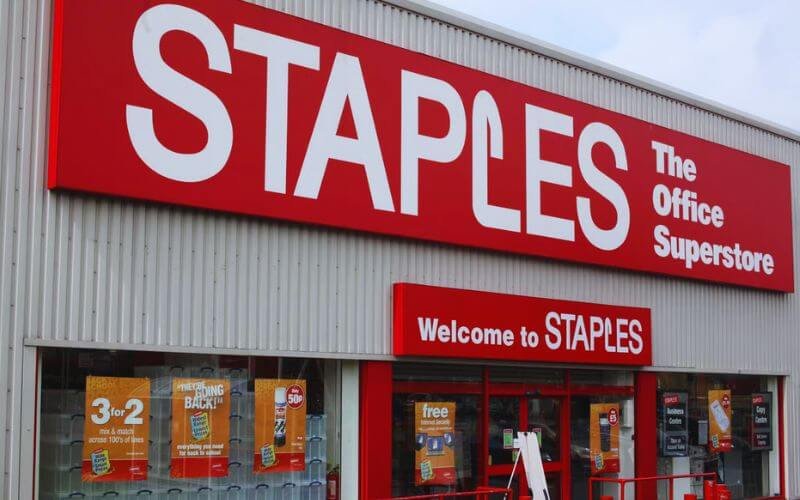


Local Staples stores are closing across the country, and the headlines make it sound like the whole company is collapsing. It is not — but the full picture is more complicated than a simple yes or no.
This article covers whether Staples is going bankrupt, why so many stores are closing, what the company is actually focused on now, and what it means for shoppers and small businesses that depend on them.
Staples Is Not Going Out of Business — But It Is Shrinking
Let’s start with the direct answer: Staples has not filed for bankruptcy. There is no liquidation announcement and no full company shutdown on the horizon.
What is happening is a real and ongoing reduction in store count. The company is closing a portion of its locations — not all of them — and shifting its focus away from traditional big-box retail.
Staples has been privately held since 2017, when Sycamore Partners acquired it. Because it’s private, detailed financial data isn’t publicly available, but its retail and B2B operations across North America remain active.
Some of the “going out of business” confusion also comes from what happened in the UK. Staples’ American owner sold the struggling UK business to Hilco Capital, which then phased out the Staples brand from UK high streets entirely. That’s a market-specific exit, not a global shutdown — but it’s easy to see how readers outside the U.S. might interpret it that way.
How Many Stores Have Closed and Where
The store count has been declining gradually, not dropping off a cliff. According to TheStreet, Staples went from around 929 stores in October 2025 to roughly 916 by early 2026 — a net loss of about 13 stores over four months.
A broader estimate from BizLixo puts U.S. store count at roughly 862 in early 2024, declining to around 833 by March 2026. These figures vary slightly depending on the source and date, so treat them as approximate rather than exact.
The bigger number getting attention is a reported plan to close approximately 225 stores across North America by mid-2026. That represents about 12.5% of Staples’ total footprint, with the company targeting around $500 million in annual savings. Separately, reports describe another 70 closures tied to declining North American sales.
Specific examples of recent and upcoming closures include:
- Frederick, Maryland — Riverview Plaza location closed March 2026 after more than 20 years
- Waterville, Maine — closed April 2026, though Augusta and Bangor locations stayed open
- Connecticut — stores in Newington, Norwich, and Norwalk closed in 2025
- Minnesota — the state’s only Staples location closed during this wave
- Goleta, California and Levittown, New York — both scheduled to close in August 2026
These are real closures affecting real communities. But they are concentrated in underperforming locations, often where leases are expiring, not a chain-wide shutdown event.
Why Staples Stores Are Closing
The office supply retail market is under serious pressure. The industry is facing what some reports describe as a $20 billion shake-up, driven by remote work, the shift to digital tools, and competition from Amazon and general big-box retailers like Walmart and Costco.
When fewer people need to stock a physical office — or when they can order printer cartridges from Amazon with next-day delivery — the foot traffic that keeps a Staples store profitable dries up fast.
According to employee discussions on Reddit’s r/Staples community, closures are often tied directly to lease expirations. When a lease comes up for renewal and the store’s numbers don’t justify the rent, Staples walks away. Stores with weak foot traffic, low print services revenue, or high occupancy costs are the most at risk.
It’s also worth putting Staples in the broader context. More than 15,000 U.S. store closures were projected for 2025, more than double the previous year. Staples is one chapter in a much larger story about retail consolidation.
Think about what Best Buy and Target have done in recent years. Both chains have closed underperforming locations while continuing to operate nationally. That kind of downsizing is a normal business response in a mature retail sector — not automatically a sign that a company is about to disappear.
What Staples Is Becoming Instead
The clearest way to understand Staples right now is that it’s pivoting away from being a physical store chain toward being a business services and supply company that also has stores.
Its B2B division — operating as Staples Professional and Staples Business Advantage — focuses on supply contracts with businesses, schools, and institutions. This segment is reportedly a high-margin part of the business and is where the company is directing more resources.
On the e-commerce side, online ordering allows customers to shop without visiting a store, which reduces the need for as many physical locations.
Inside remaining stores, Staples has been adding service-based offerings that are harder to replicate online:
- Stanton Optical eye care centers in select locations
- Passport photos and TSA PreCheck enrollment services
- Verizon tech services piloted in some stores in 2025
- Print and marketing services, which employees identify as a core profit driver at the store level
A surviving Staples store looks less like a warehouse for office supplies and more like a service hub. That shift is intentional. The company is betting that services — printing, shipping, identity documents, tech help — will keep people walking in when the “just grab some pens and paper” trips have mostly moved online.
What This Means for Shoppers and Small Businesses
If your local Staples is closing, you have a few realistic options depending on your situation.
For basic office supplies, Amazon and Walmart cover most needs with delivery. For printing, FedEx Office and UPS Store locations are the most direct alternatives, though costs and capabilities vary.
If you run a small business that depends on Staples for regular supply orders, it’s worth looking into a Staples Professional account. Moving to a B2B account often gives you better pricing and delivery options than walking into a retail store anyway.
For businesses that use in-store printing services regularly, now is a practical time to identify backup vendors before your local store closes — not after.
Resources like eBusiness Voice cover business tools, services, and vendor decisions that can help you think through these kinds of operational shifts.
How to Check If Your Local Staples Is Closing
There are a few practical ways to stay ahead of a closure rather than being caught off guard.
First, use Staples’ own store locator or simply search the location on Google Maps. Closures are sometimes reflected there before official announcements.
Second, watch for signs that employees on Reddit identify as early indicators: lack of store investment, no recent remodeling, visible inventory drawdown, and especially if you hear that a lease is coming up for renewal.
Third, local news outlets tend to report upcoming closures weeks or even months in advance. Searching “[your city] + Staples closing” in Google News is a quick way to check.
The Bottom Line
Staples is not going out of business. It is, however, a smaller company than it was five years ago, and it will likely be smaller still by the end of 2026.
The closures are real, the pressure on the business is real, and the industry shift is real. But what’s happening is a strategic pullback from underperforming retail locations — not a collapse. The company is still taking B2B contracts, running e-commerce, and keeping stores open in markets where the economics work.
If you’re a shopper losing a convenient store, that’s genuinely frustrating. If you’re a business owner who relies on Staples for supplies or printing, this is a good moment to review your vendor setup and make sure you’re not caught without a backup plan. Either way, knowing what’s actually going on puts you in a better position than reacting to headlines that overstate the story in both directions.
Also Read: